

AI- Native CustomSoftware Development
Custom Software Development Services
Custom software development services turn the way your business actually works into software you own, instead of bending your process around tools built for someone else. Nexvertise Digital has built software since 2018 for startups, small businesses and enterprise teams in the USA and abroad. We design and build SaaS platforms, AI-powered
applications, internal tools and integrations, using AI-native workflows with engineers
reviewing every AI-assisted change before it ships.

What Are Custom Software Development Services?
Custom software development services cover the planning, design, building, testing and maintenance of software made for one organization’s users, processes and goals. Unlike off-the-shelf software sold to thousands of companies, custom software fits your workflow, connects to the systems you already use, and belongs to you.
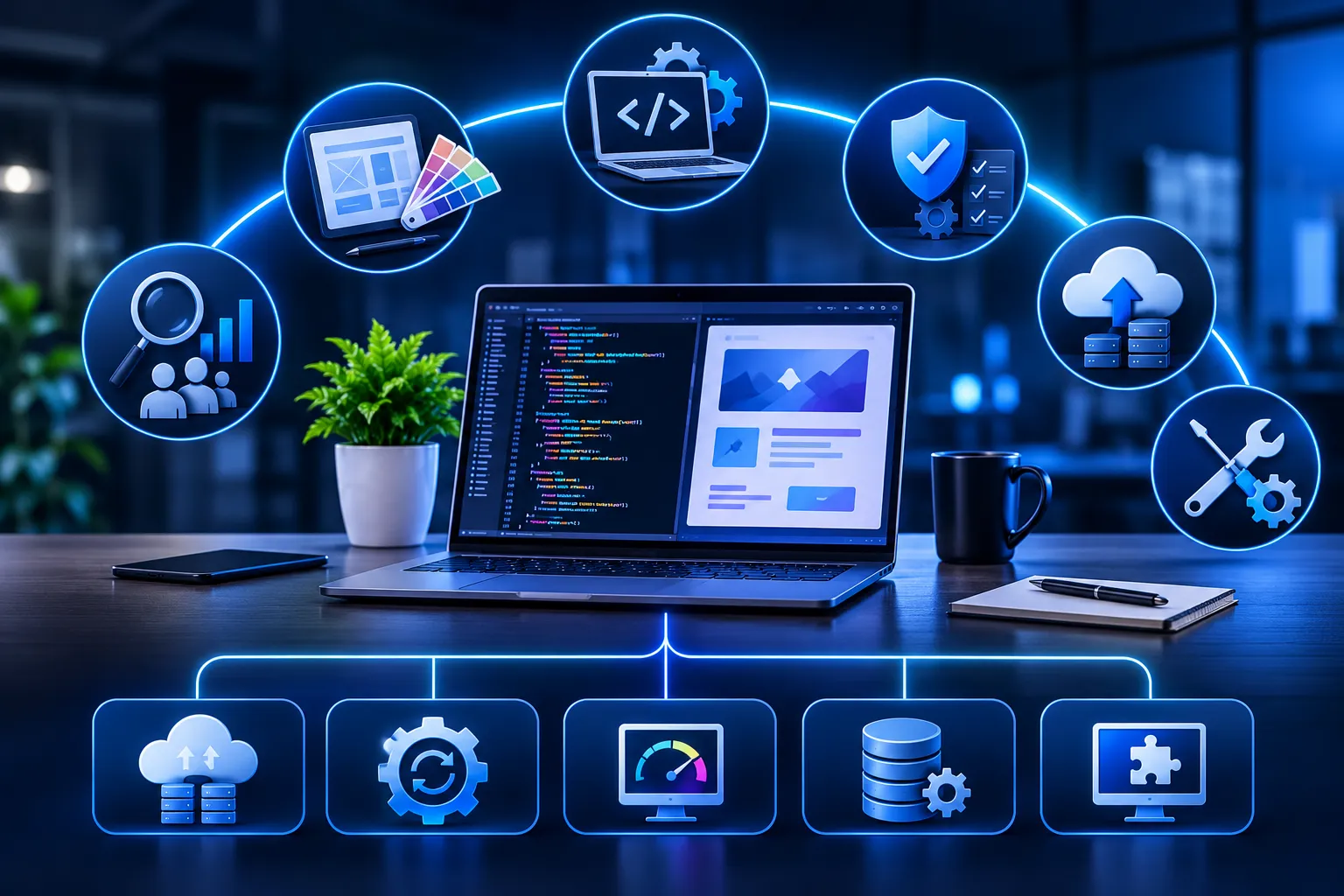
A full engagement usually includes discovery and requirements, UI/UX design, software architecture, development, quality assurance, deployment and ongoing maintenance. Some clients need all of it. Others need one piece, such as an API integration or a rebuild of a slow legacy tool.
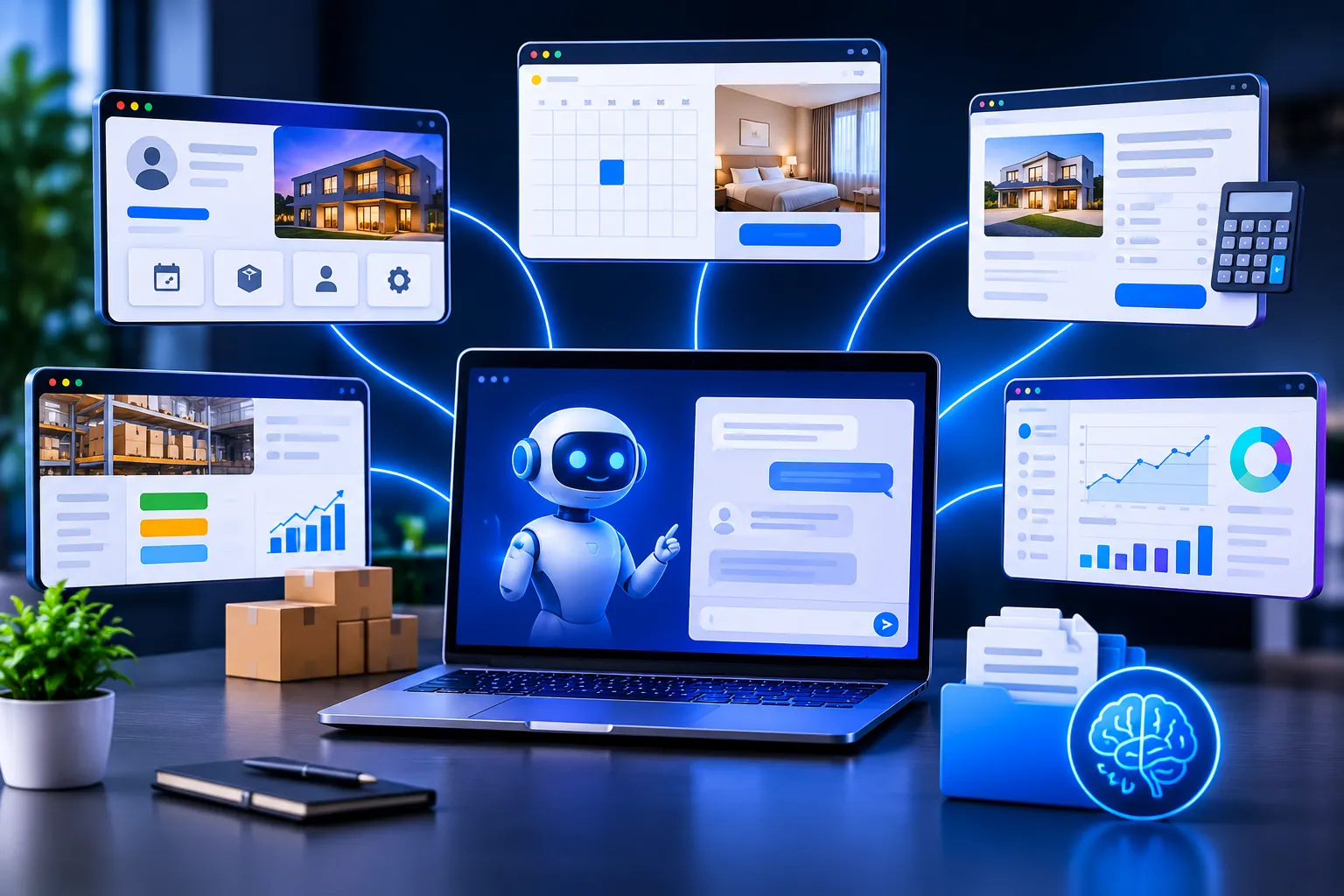
Typical projects range from a customer portal or booking platform to a quoting tool, an inventory dashboard, a SaaS product, or an AI assistant trained on a company’s own documents.
Demand keeps rising
Global Custom Software Market
Grand View Research estimates the global custom software development market at USD 53.5 billion in 2026 and projects USD 178.9 billion by 2033, an 18.8% annual growth rate. North America held 33.6% of revenue in 2025.

Custom Software vs. Off-the-Shelf vs. Low-Code: Which Do You Need?
Buy off-the-shelf software for standard functions, use low-code for simple internal apps, and build custom software for the processes that set your business apart. Most companies end up with a mix of all three.
Upfront cost
Lowest (subscription)
Cost as you grow
Rises with every seat or tier
Fit to your process
You adapt to the tool
Integrations
Limited to the vendor’s connectors
Ownership
Vendor owns code and roadmap
Time to first version
Days
Best for
Email, payroll, accounting, other standard tasks
Upfront cost
Low to medium
Cost as you grow
Rises with users and platform plans
Fit to your process
Good for simple workflows
Integrations
Platform connectors only
Ownership
Locked to the platform
Time to first version
Weeks
Best for
Forms, simple internal apps, prototypes
Upfront cost
Highest
Cost as you grow
Mostly hosting and maintenance; no per-seat license
Fit to your process
Built around your process
Integrations
Any system with an API, plus custom ones
Ownership
You own the code
Time to first version
Weeks to a few months
Best for
Core workflows, products you sell, complex integrations
The comparison that matters most is total cost of ownership over three to five years, not the first invoice. A subscription that looks cheap at 10 users can cost more than a custom build at 200, and workarounds add hidden technical debt.
6 Signs Your Off-the-Shelf Tools Have Hit Their Limit
- Staff re-enter the same data into two or more systems every day.
- You pay for a higher tier mostly to unlock one or two features.
- Critical workarounds live in spreadsheets only one person understands.
- You’ve asked the vendor for a feature and it isn’t on their roadmap.
- Integrations break whenever either vendor ships an update.
- Your customers’ experience is limited by what the tool allows.
If three or more apply, a custom build or a targeted integration is worth pricing.
Custom Software Solutions We Build
We build six kinds of custom software solutions. Most projects combine two or three, for example a web application with an AI feature and several integrations.

SaaS Platforms and Multi-Tenant Web Applications
We build subscription products from first login to billing. That includes multi-tenant architecture that keeps each customer's data separate, user roles and permissions, subscription billing, admin dashboards and usage analytics. Designed to scale on cloud infrastructure so a jump from 50 to 5,000 accounts is a hosting change, not a rewrite.
Business Process and Workflow Automation
Custom business software development replaces manual processes. Typical builds include quoting and estimating tools, approval workflows, job and inventory tracking, custom CRM and ERP modules, and real-time dashboards. Fewer hours spent on data entry and fewer errors.
Web and Mobile Application Development
Browser-based web applications, customer and partner portals, and native or cross-platform mobile apps for iOS and Android. Cross-platform mobile apps share one codebase across both stores, lowering build and maintenance costs.
API Development and Third-Party Integrations
We connect the tools you already pay for so data moves without copy-and-paste. Covers CRMs, accounting software, payment gateways, ERPs, shipping and marketing platforms, plus custom APIs. Mapped and tested in the first weeks.
MVP and Software Product Development
We start with the smallest version that tests your riskiest assumption, scoped around one core user journey. Shipped quickly, and written to survive success with no throwaway prototype required.
Legacy System Modernization and Data Migration
We modernize old systems in stages: refactor what still works, rebuild what doesn't, and migrate data with validation checks at each step. Old and new systems run side by side until proven, eliminating risky cutover weekends.
AI-Powered
Software Development
AI-powered software development means building AI features into your product and using AI inside our engineering workflow to deliver faster, with engineers accountable for every result.
AI Features We Build Into Your Product
- AI assistants and chatbots grounded in your own documents and data, so answers come from your content rather than the open web.
- Document processing that reads invoices, forms or contracts and extracts the fields your team types in by hand today.
- Machine learning models for forecasting, lead scoring, anomaly detection and recommendations.
- Agentic AI that completes multi-step tasks, such as triaging support tickets, with a human approval step before anything irreversible.
- AI integration into existing systems through APIs, adding intelligence without replacing the platform.
With

How We Use AI in Our Own Engineering
In the 2026 Stack Overflow Developer Survey, 73% of developers who use AI coding assistants use them daily. Trust still depends on checking: 93% said they need source attribution to trust AI output. Google’s DORA 2025 report found that AI amplifies a team’s existing strengths and weaknesses. Our 4 strict rules reflect that:
AI drafts, engineers decide. AI-assisted code goes through human code review before it merges.
Tests gate every release. Automated tests must pass in the CI/CD pipeline before anything ships.
Your data stays private. Client code and data are not pasted into public AI tools.
Seniors spend time where it counts. AI handles boilerplate and first drafts so engineers focus on architecture and security.
The result is faster delivery without handing judgment to a model.
- BUILT FOR EVERY BUSINESS
Custom Software Developmentfor Startups, SmallBusinesses andEnterprises
The same four-stage process serves very different buyers. What changes is the priority:
speed for startups, return on investment for small businesses, and risk control for
enterprises.
MVPs and Time-to-Market
Founders need to learn whether customers will pay before the runway runs out. We help you cut the feature list to what tests demand, launch an MVP real users can sign up for, and keep architecture clean enough to scale without a rebuild.

Replacing Manual Processes
When off-the-shelf software and spreadsheets stop keeping up, we focus on workflows that eat the most staff time—scheduling, quoting, order handling and reporting—and automate them first with phased rollout.

Legacy Systems & Compliance
We modernize legacy systems in stages, add AI to existing platforms, integrate with CRM/ERP systems, work alongside in-house developers in your repositories, and build to strict security and data regulations.
Our Custom Software Development Process
Our custom software engineering services follow four stages. Each stage ends with a deliverable you approve before the next one begins.
| Stage | What You Receive | Your Involvement |
|---|---|---|
| 1. Strategic Discovery | Scope, product roadmap, fixed price, timeline | Workshops and interviews |
| 2. Architecture & Design | Architecture plan, clickable prototype, approved designs | Design reviews |
| 3. Agile Execution | Working software every sprint | Sprint demos and feedback |
| 4. Launch & Scale | Live product, documentation, support plan | Launch sign-off |
Strategic Discovery
Requirements, roadmap, budget and timeline.
Architecture & Design
System architecture, security and prototypes.
Agile Execution
Regular demos, testing and quality reviews.
Launch & Scale
Deployment, monitoring and ongoing support.
How We Build Security and Quality
Into Every Project
IBM’s 2026 Cost of a Data Breach study puts the global average breach at $4.99 million, and 1 in 4 malicious breaches is now AI-enabled. Security is designed in from day one.
Our practices follow two public references: the NIST Secure Software Development Framework (SP 800-218) and the OWASP Top Ten. In practice that means:
Threat review during Architecture & Design
Least-privilege access and encryption
Code review on every change, including AI code
Automated tests & dependency checks in CI/CD
Testing against OWASP Top Ten risks
Staging environments, backups & rollback plan
Our Technology Stack
We choose the technology stack based on your team, existing systems, and scale requirements, not our preferences.
| Layer | Technologies |
|---|---|
| Front end | React, Next.js, TypeScript |
| Back end | Node.js, Python (Django, FastAPI), PHP (Laravel) |
| Mobile | Flutter or React Native, Swift, Kotlin |
| AI and machine learning | LLM APIs, LangChain, PyTorch, scikit-learn |
| Databases | PostgreSQL, MySQL, MongoDB, Redis |
| Cloud and DevOps | AWS, Microsoft Azure, Google Cloud, Docker, Kubernetes, GitHub Actions |
How Much Does Custom Software Development Cost, and How Long Does It Take?
Custom software development cost depends mainly on scope, integrations, platforms and compliance needs. At Nexvertise, a focused MVP typically costs a fraction of a full platform and takes a few weeks to a few months while a full business platform typically costs considerably more over several months. Discovery turns your requirements into one fixed price for your project.
What Drives the Cost
Keeps cost lower
One core workflow, few user roles
Pushes cost higher
Many workflows, roles and permissions
Keeps cost lower
None, or well-documented APIs
Pushes cost higher
Legacy systems, custom data migration
Keeps cost lower
Web only
Pushes cost higher
Web plus iOS and Android
Keeps cost lower
Calls to existing AI models
Pushes cost higher
Custom-trained machine learning models
Keeps cost lower
Standard business data
Pushes cost higher
Regulated health, payment or financial data
Keeps cost lower
Proven UI components
Pushes cost higher
Fully custom interface and branding
Keeps cost lower
Offshore or nearshore teams
Pushes cost higher
Onshore US agencies or in-house hires
Team rates are the factor buyers underestimate most. If you plan to hire in-house instead, the U.S. Bureau of Labor Statistics publishes current pay and demand data for software developers, QA analysts and testers.
Typical Project Timelines
- MVP or single-workflow tool: usually a few weeks to a few months
- Business platform with integrations: usually several months
- Legacy modernization: timeline varies with system size and complexity, delivered in phases so value arrives before the final cutover
The biggest timeline risks are unclear requirements and slow feedback, which is why discovery comes first and demos happen every sprint.
How Our Pricing Works
The price agreed at kickoff is the price you pay, with no upsells later. If you add scope mid-project, we quote the change in writing before any work starts. Our rates run about 60% below typical US and UK agency rates because of our team location and AI-native workflow. You can see current packages on our pricing page.
We work on a fixed-scope project basis, or as an ongoing monthly development partner for new features, support and maintenance.
$178.9B
Projected by 2033

How to Choose a Custom Software Development Company
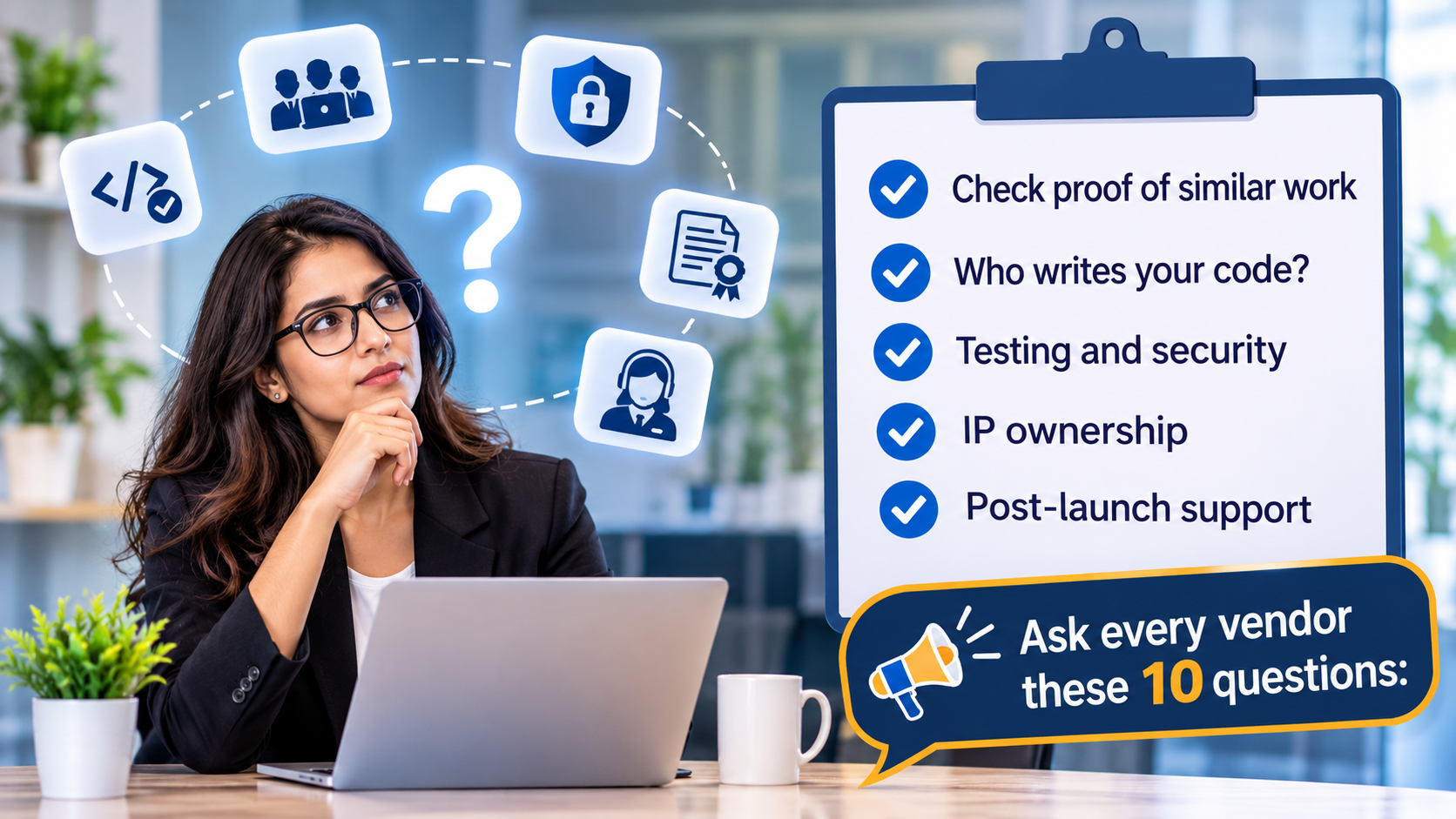
Check proof of similar work, who writes your code, testing and security, IP ownership, and post-launch support. Ask every vendor these 10 questions:
- Can you show software, not just websites, that you've built, and can I speak with that client?
- Who will write my code, and can I talk to them directly?
- Who owns the source code, designs and IP, and when does ownership transfer?
- How do you estimate cost, and what happens when scope changes?
- How do you use AI in development, and who reviews its output?
- What testing runs before every release?
- How do you protect my data and control access to it?
- How will I see progress between milestones?
- What does support cost after launch, and what's the response time?
- If we stop working together, what do I receive: code, documentation, credentials?
Red Flags to Watch Out For: A firm price before any discovery, no access to developers, vague answers on code ownership, and no plan for maintenance.
Why Choose Nexvertise as Your Custom Software Development Partner
Nexvertise Digital is an AI-native software, web and search agency that has been building
since 2018. Five things set our custom software development services apart, and one
section below says when we’re the wrong choice.
01
Talk Directly to the Developers Building Your Software
There are no account managers between you and your custom software developers. You
get a shared channel with the engineers writing your code, so a question about a feature
is answered by the person building it, usually within one business day. Fewer hand-offs
mean fewer misunderstandings and faster decisions.
02
AI-Native Delivery With Human Code Review
AI-native workflows speed up drafting, testing and documentation, and engineers review
every AI-assisted change before it merges. You get the speed of modern tooling without
trading away judgment, as described in the AI section above.
03
Senior Engineering at ~60% Lower Cost
Rates run about 60% below typical US and UK agency rates, allowing startups and small businesses to afford senior-level engineering.
04
24/7 "Follow the Sun" Support
Our team works across time zones, so support and bug investigation continue while your office is closed.
05
Software, Web & Search Under One Roof
We also provide custom web design, SEO, AEO and GEO services so your SaaS launches with marketing and search visibility built-in.
When We're Not the Right Fit
- Your procurement requires ISO 27001 / SOC 2.
- You need engineers on-site at a US office daily.
- An affordable off-the-shelf tool handles 90% of the job.
- You want to start coding without discovery or scope.
Frequently Asked Questions
Everything you need to know about our custom software development services.
Custom software is worth it for a small business when a manual process or software limit costs more each year than building and maintaining a fix. Add up staff hours lost to re-entering data, fees for tools you only half use, and revenue lost to slow service. If that total covers the build cost within two to three years, building usually wins. If an affordable off-the-shelf tool already fits most of your process, buy it instead. We'll tell you which applies in a free consultation.
That's a normal starting point. Strategic Discovery exists to turn an idea into clear business requirements, user flows, a ranked feature list and a product roadmap. You bring what you know about your customers and the problem. We bring the questions that expose risks, hidden costs and features you can skip at launch.
Yes. Most projects connect to systems you already run, such as a CRM, accounting software, payment gateway, ERP or legacy database through APIs. We can also work as an extension of your in-house team inside your repositories and sprint rhythm.
StartWith a Free Strategy Consultation
Tell us what you want to build or fix. In a free call with one of our engineers, you’ll get:
- An honest view on whether to build, buy or integrate
- The main cost drivers and risks for your idea
- A recommended next step, whether or not it involves us